By Drake Miller – senior content manager and academic strategy consultant
The American classroom is undergoing a seismic shift. Gone are the days when “EdTech” simply meant a bulky overhead projector or a rolling TV cart. Today, the integration of technology into the United States education system is moving at a pace that is both exhilarating and, at times, overwhelming.
For high school students preparing for college and university students looking toward the workforce, understanding these shifts is no longer optional—it is a survival skill. From the integration of Agentic AI to the “phygital” transformation of lecture halls, the future of learning is personalized, immersive, and data-driven.
In this article, we explore the definitive trends shaping the future of EdTech in the USA and how you can leverage them to stay ahead of the curve.
1. The AI Revolution: From Tutors to Co-Pilots
Artificial Intelligence remains the most significant disruptor in modern education. However, as we move through 2026, the narrative has shifted from “will students cheat?” to “how do students achieve AI literacy?”
Hyper-Personalized Learning Paths
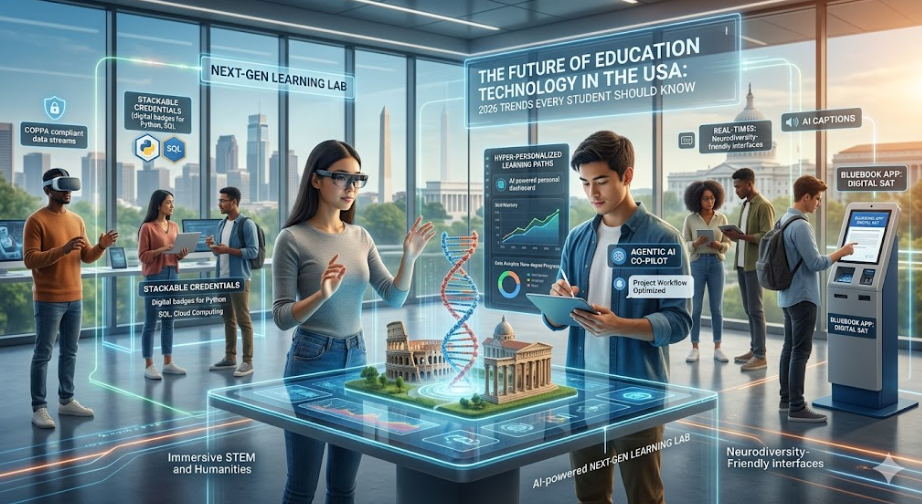
Traditional “one-size-fits-all” instruction is being replaced by AI-driven platforms that adapt to your specific learning pace. In major school districts from California to New York, machine-learning algorithms now curate custom problem sets. If you struggle with the “Preparing for Higher Math” category on the ACT but excel in literature, these systems focus your energy on quadratic equations while letting you breeze through areas you’ve already mastered.
However, even with AI assistance, the sheer volume of digital coursework can become taxing. Many students now balance these automated tools with professional human support, often choosing to do my assignment online to ensure they maintain a high GPA while mastering new technologies.
24/7 Academic Support and “Agentic AI”
The limitation of the human teacher is time. Students often find themselves stuck on a complex assignment at 11:00 PM with no one to ask for help. We are now seeing the rise of Agentic AI—tools that don’t just answer questions but help manage your entire project workflow. Whether it’s brainstorming an essay outline for a Common App prompt or seeking a reliable expert to do my coding assignment by debugging a line of Python code, these tools act as round-the-clock co-pilots.
2. Immersive Learning: VR, AR, and the XR Classroom
Virtual Reality (VR) and Augmented Reality (AR) have moved out of the gaming world and into the American lecture hall. Extended Reality (XR) is now a core component of STEM and Humanities curricula at institutions like MIT and Stanford.
Virtual Lab Experiments
For STEM students, VR allows for high-stakes experimentation without high costs or safety risks. Imagine performing a complex chemistry titration or exploring the inner workings of a human heart in a 360-degree virtual space. This “learning by doing” approach has been shown to increase retention rates by up to 75% compared to traditional textbook reading.
Historical and Global Exploration
In the humanities, AR brings history to life. Instead of looking at a flat map of the Roman Empire, students can use AR glasses to “walk” through a digital reconstruction of the Colosseum. For US students, this bridge between the physical and digital worlds makes abstract concepts tangible and memorable.
3. The Digital SAT and Enhanced ACT: Tech-Driven Testing
Standardized testing in the USA has seen its most significant redesign in decades. By early 2026, the Digital SAT (administered via the Bluebook app) is the global standard, featuring a multistage-adaptive design that changes question difficulty based on your performance in the first module.
Similarly, the “Enhanced ACT” has rolled out nationally, offering a faster core experience with optional Science sections. Students today must be “tech-ready” for test day, mastering embedded tools like the Desmos graphing calculator, which is now a native part of the SAT testing interface.
4. Data Privacy: Navigating COPPA and FERPA in 2026
As we move more of our academic lives online, the “Digital Footprint” is a major concern. In the USA, the Federal Trade Commission (FTC) has finalized major updates to the Children’s Online Privacy Protection Rule (COPPA), effective April 2026. These updates strengthen parental notice requirements and limit how EdTech companies can use student data for AI training.
Understanding FERPA (Family Educational Rights and Privacy Act) is equally critical for college-bound students. You must be a savvy consumer of technology, knowing who owns your uploaded assignments and how your biometric data (often used for “proctored” online exams) is stored and protected.
5. Micro-Credentials and the Lifelong Learning Model
The traditional four-year degree is no longer the only path to success in the American job market. We are seeing a massive rise in “Stackable Credentials”:
- Nano-degrees: Focused, short-term courses in specific skills like Data Analytics or Cloud Computing (AWS/Azure).
- Digital Badging: Verifiable tokens that prove you have mastered specific software, like Python or SQL.
- Hybrid Pathways: A mix of traditional university courses and industry-recognized certifications.
This allows students to tailor their education to the specific needs of the 2026 workforce, where employers often prioritize skills over specific degree titles.
6. The Rise of “Phygital” and Flipped Classrooms
The “Physical + Digital” (Phygital) classroom is the new standard. Post-pandemic, US schools have realized that the best environment is a hybrid one. Even in-person classes now utilize “flipped classroom” models. In this setup, you watch a video lecture at home and use valuable classroom time for discussion, collaboration, and hands-on problem-solving with the instructor. This maximizes human interaction where it matters most.
7. Accessibility and Universal Design
One of the greatest promises of EdTech is its ability to level the playing field. For the millions of US students with disabilities, technology is a vital equalizer.
- AI Captions: Real-time captioning of lectures helps students who are hard of hearing or for whom English is a second language.
- Neurodiversity-friendly Interfaces: Software designed with customizable layouts helps students with ADHD or Dyslexia focus better by removing visual clutter.
- Speech-to-Text: Now standard in most operating systems, these tools assist students with motor impairments in drafting complex papers.
8. High-Value Skills for the 2026 Workforce
As technology becomes more prevalent, paradoxically, “Human Skills” are becoming more valuable. US employers in 2026 are looking for:
- Critical Thinking: Can you tell the difference between an AI-generated “hallucination” and a fact?
- Collaboration: Can you work in a team that spans time zones using tools like Slack, Trello, or Microsoft Teams?
- Cybersecurity Hygiene: Understanding how to protect your identity and intellectual property in a digital ecosystem.
- Prompt Engineering: The ability to effectively communicate with LLMs to produce high-quality professional output.
9. The Cost Factor: Bridging the Digital Divide
While high-end VR gear is expensive, the democratization of information through Open Educational Resources (OER) is making learning more affordable. Students can now access Ivy League-level lectures for free on platforms like Coursera or YouTube. The challenge for 2026 remains ensuring the “Digital Divide”—the gap between those with high-speed internet and those without—does not widen as basic education moves into the cloud.
See also: A Complete Guide to Hypodermic Needle in Medical Practice
Frequently Asked Questions
Q.1 How does “Agentic AI” differ from the AI tools I used in 2025?
While earlier AI acted as a passive chatbot, Agentic AI acts as an autonomous partner. In the modern classroom, these agents don’t just answer questions; they can manage your study schedule, proactively find research papers, and even suggest when you need to take a break based on your engagement data.
Q.2 What exactly is a “phygital” lecture hall?
“phygital” space merges physical attendance with digital immersion. This often involves using Augmented Reality (AR) headsets to see 3D models of what the professor is discussing or using real-time digital “heat maps” that show the instructor which concepts the students in the room are currently struggling to grasp.
Q.3 Is AI literacy more important than subject mastery?
It is a balance. In 2026, knowing how to prompt and verify AI output is considered a “core-competency,” much like reading or writing. However, subject mastery remains essential so you can provide the human oversight needed to catch “hallucinations” or logical errors in AI-generated work.
Q.4 Can these EdTech tools help with the “soft skills” employers want?
Surprisingly, yes. Many new platforms use VR simulations to help students practice high-stakes scenarios like job interviews, medical bedside manners, or conflict resolution in the workplace, providing data-driven feedback on tone and body language.
Conclusion
The future of Education Technology in the USA is not about replacing teachers with robots or books with screens. It is about empowerment. As we move toward 2030, the students who succeed will be those who view technology not as a distraction, but as a powerful extension of their own potential. The classroom of the future has no walls—it is limited only by your curiosity and your willingness to adapt.
About the Author
Drake Miller is a blog author, senior content manager and academic strategy consultant with over 12 years of experience in the higher education sector. Based in London and Sydney, Drake specializes in the ethical integration of Agentic AI and Large Language Models (LLMs) into student workflows. His work focuses on helping students navigate the complexities of digital wellness, deep work, and the evolving technological landscape of modern academia.